Laying a Crawl Space Vapor Barrier Under an Indianapolis Home
Bare dirt under a house releases moisture every day of the year. A crawl space vapor barrier is the plastic that stops it, and Indiana's code is specific about how it goes down.
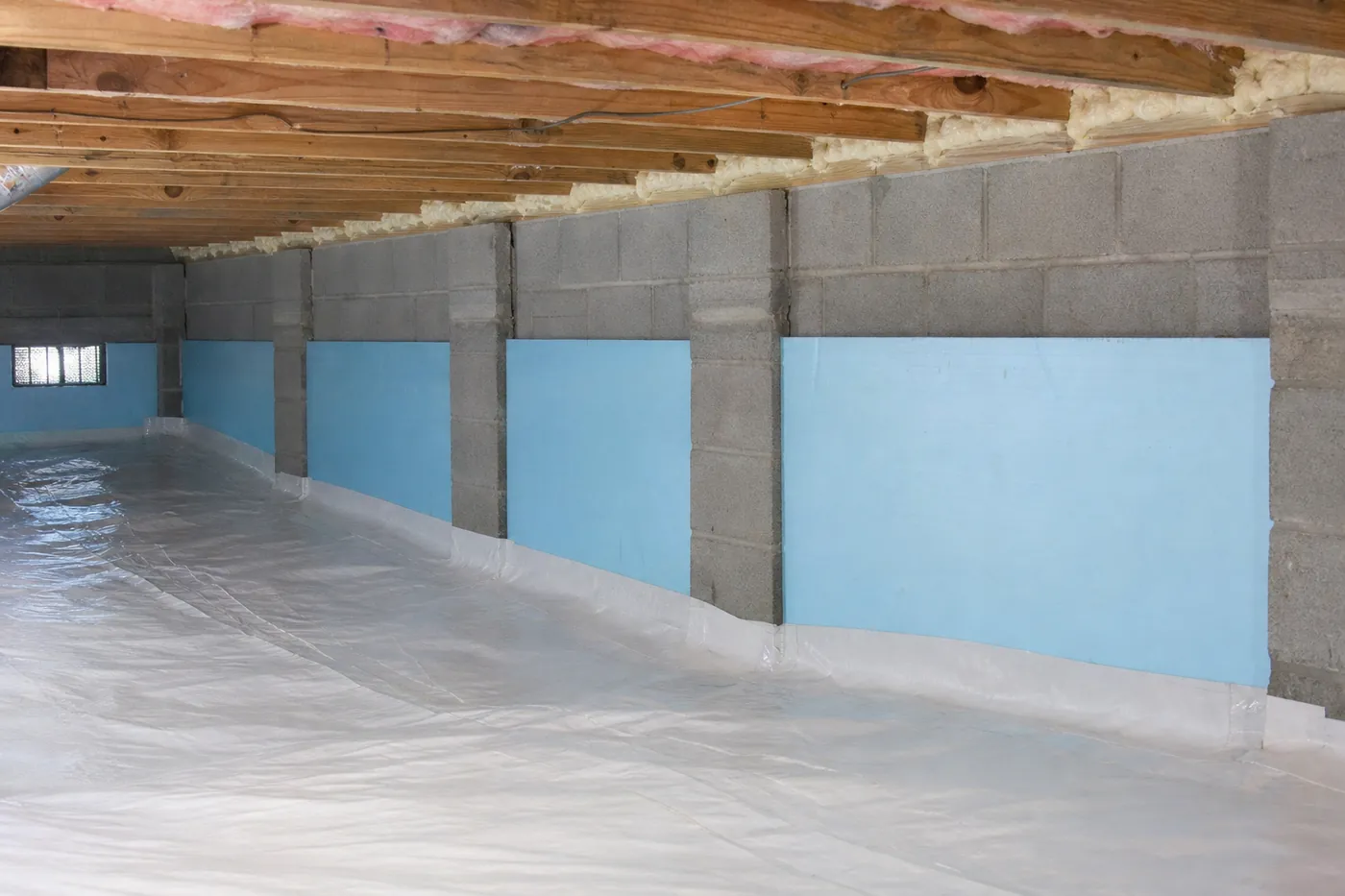
For a 1,500 square foot crawl space, Fixr (2025) prices new plastic at $1,500 to $4,000. In a crawl space without vents, Indiana's code asks for a continuous Class I vapor retarder over the exposed earth, joints overlapped 6 inches and sealed or taped, with edges run at least 6 inches up the wall.
What Indiana's code says about the plastic
The rule is item 1 of Section R408.3 in the 2020 Indiana Residential Code. Class I is the least vapor-permeable category. The edges are attached and sealed to the stem wall, or to the wall insulation.
Indiana then ties the plastic to drainage. Its Section R408.8 says the ground under it must slope to a gravity discharge or a sump pit at least 18 inches across and 24 inches deep. One method grades the soil at 1 inch per 10 feet. The other grades it at half that and puts at least 3 inches of granular material, such as gravel, between the soil and the vapor retarder (675 IAC 14-4.4-56).
A thin sheet or a full liner?
A ground sheet covers the floor. A liner is heavier, sealed at the walls, piers and every seam, and often carried higher up the walls. Thin builder-grade plastic tears under knees and tools, so the next plumber or cable installer can undo it. Thicker, reinforced material costs more and survives traffic. Ask for the thickness in mil, whether it is reinforced, and how high it runs on the walls.
Signs an old crawl space vapor barrier is no longer working
- Dirt showing through gaps, or sheets shoved into a heap.
- Puddles sitting on the plastic after a storm.
- Seams left loose, or tape peeling away.
- Mold spots on the sheet or the framing above it.
Can the liner help with radon too?
It can be built to. In its Consumer's Guide to Radon Reduction, the EPA says the most effective method for crawl space homes is a plastic sheet over the earth floor with a pipe and fan drawing radon from under it. Seams and edges have to be sealed for that to work. Marion County is EPA Radon Zone 1, so a test before the plastic goes down is worth the small effort. The radon guide has the order of work, and the price ranges for each part of encapsulation show where the liner fits.
Questions homeowners ask
Does the plastic have to cover the whole wall?
Not by Indiana's minimum, which is 6 inches up the stem wall, attached and sealed. Many full liners go higher, and most of the ways Indiana's code allows to close a crawl space call for insulated walls, so ask how the liner and the wall insulation meet.
Describe the crawl space in a sentence or two
Pick the closest match, then add what you noticed: a smell upstairs, water on the plastic after a storm, a floor that gives underfoot. A crawl space specialist who works in Indianapolis phones you to talk it through.